
DesignShift Practice Session: From Lines to Loops
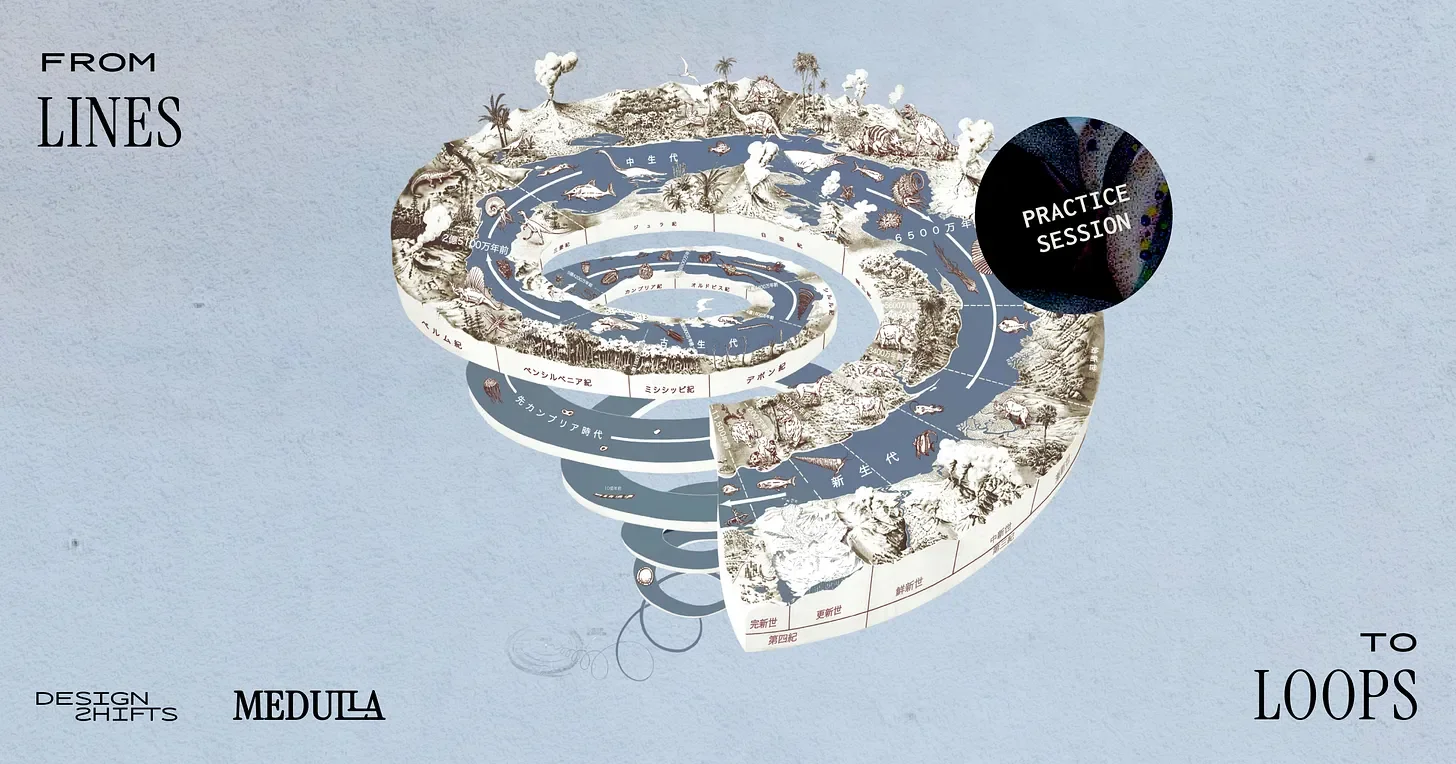
In June 2026, we hosted a DesignShifts event exploring what it means to shift beyond the dominant time narratives.
This event was a collaboration between DesignShifts and What Grows Between Us: Tending to Time, with facilitation by Ida Persson, sahibzada mayed, and Christine Flanagan.
About the gathering
We have inherited a story that time moves in one direction, at one speed, toward one kind of future. Progress. Growth. Optimization. That linear time is neutral and objective. But it never was. The dominant clock was built to serve particular interests, particular speeds, particular kinds of forgetting, and a specific kind of linear pace. We know this, yet most of us still plan, create, and measure our impact inside these dominant rhythms of time.
But what if we didn't have to? What if we could enter different, more generative timescapes? This is what we’ll explore together in this gathering.
This is what we explored together in Berlin. The event was hosted at Medulla — a physical space for turning shared urgency into collective resilience.
Session reflection and observations
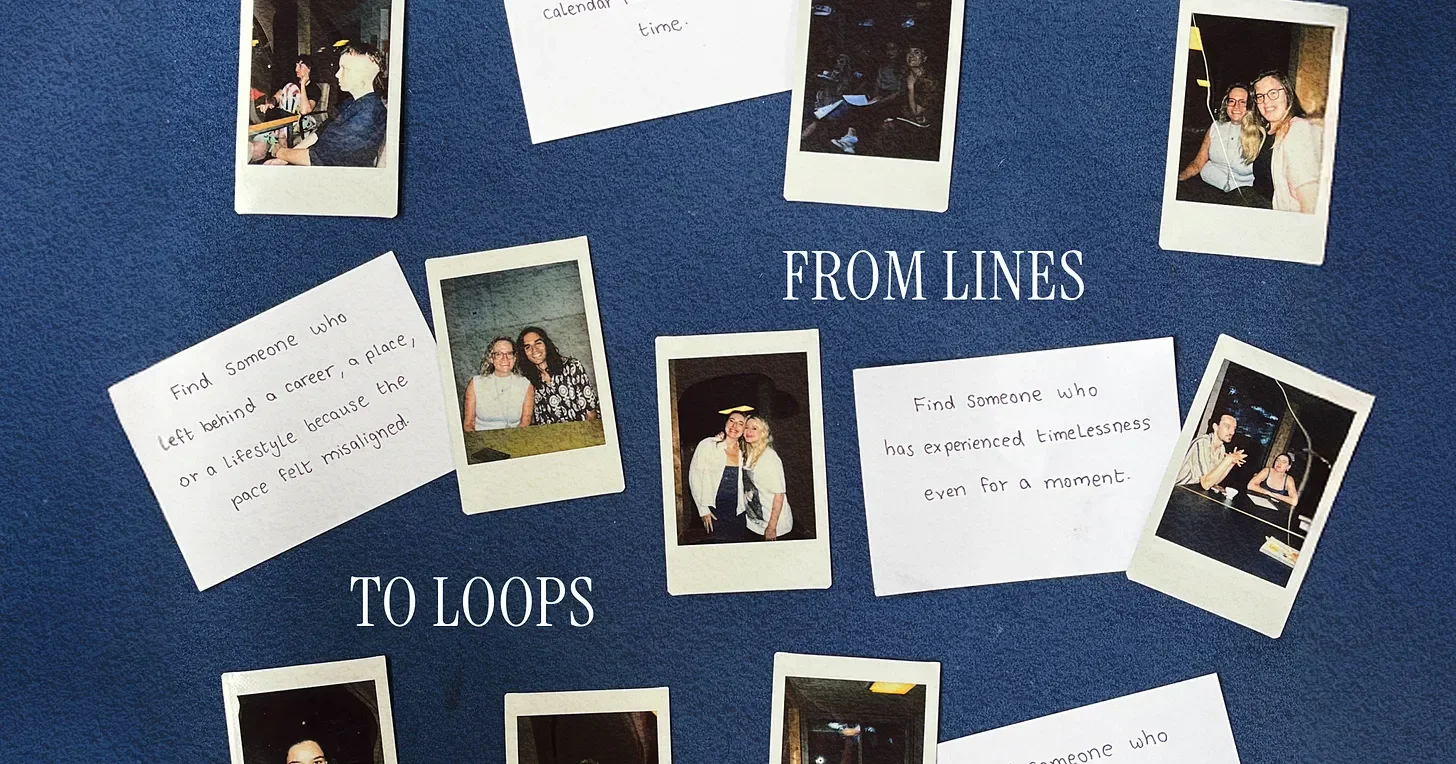
For 3 hours, we entered a space of reflection, silence, processing, and responsibility. The space was fluid but a big activity we did was to explore the following timescapes in groups:
Bodies at the Threshold
To speak of time is to speak in the language of the body: breath, sensation, fatigue, safety, pause.
If your body kept its own clock, what would it refuse to rush?
Lineages of Time
To speak of time is to remember that we are not singular beings. We are made of ancestors, memories, stories, and futures unfolding across generations.
Whose time are you still carrying?
Time as a Living System
To speak of time is to learn from the natural world, where rest, renewal, emergence, growth and decay each have their season.
What rhythms are you ready to let go of, so something else can take root?
What Grows Between Us
To speak of time is to speak of what becomes possible only when we move through it together.
What becomes possible when you're no longer keeping time alone?
The prompts were invitations to dive deep into the topics, but more importantly, the groups had time and space to share their own relationship, experiences, and feelings about time.
There is no way to summarize all themes that emerged, but some of the things I'm sitting with:
The places and objects that keep us connected to the past.
The moments where time stops without us knowing who or how.
The fear of death, the feeling of time slipping away.
And much, much more.
We entered spirals of time, rabbit holes, deep time, and flow states.
It was a session that danced with pleasure and pain, laughter and tears, the individual and the collective, the fast and the slow, all while moving between past, future, and present time.
Final reflection
As this reflection comes to a close, we're reminded of where we started, with the realization that time is not linear, and trying to fit it into calendar blocks, quarterly goals, and a system that doesn't stop for anything keeps us from experiencing loops and life to its fullest. It keeps us from listening when our bodies beg us to rest. It keeps us from connecting to the rhythms of the natural world, which doesn't move at a constant speed of growth.
We're encouraged to explore more in-person gathering moving forward, and we're reminded of this quote from adrienne maree brown:
"Real time is slower than social-media time, where everything feels urgent. Real time often includes periods of silence, reflection, growth, space, self-forgiveness, processing with loved ones, rest, and responsibility."
