

In September 2026, we hosted a DesignShifts workshop introducing the Design Beyond Commerce frameworks.
This event was a collaboration with The School of Radical Imagination.
About the gathering
This workshop centered around a simple question: what becomes possible when we shift the focus of design away from commerce towards other values?
Design has long shaped what we buy, how businesses grow, and why we keep coming back for more. It has opened doors to new things, but it has also deepened ecological harm, hollowed out communities, and pulled culture further into a cycle of consumption.
In this workshop, you'll be introduced to a framework for shifting the purpose of design beyond the market and toward five alternative values. Instead of designing for growth, efficiency, or what sells, we'll look at what becomes possible when we design for Care, Community, Craft, Culture, and Contentment instead.
Together, we questioned what design is for, who it serves, and what it could help make possible when commerce is no longer the starting point or the end goal.
Session reflection and observations
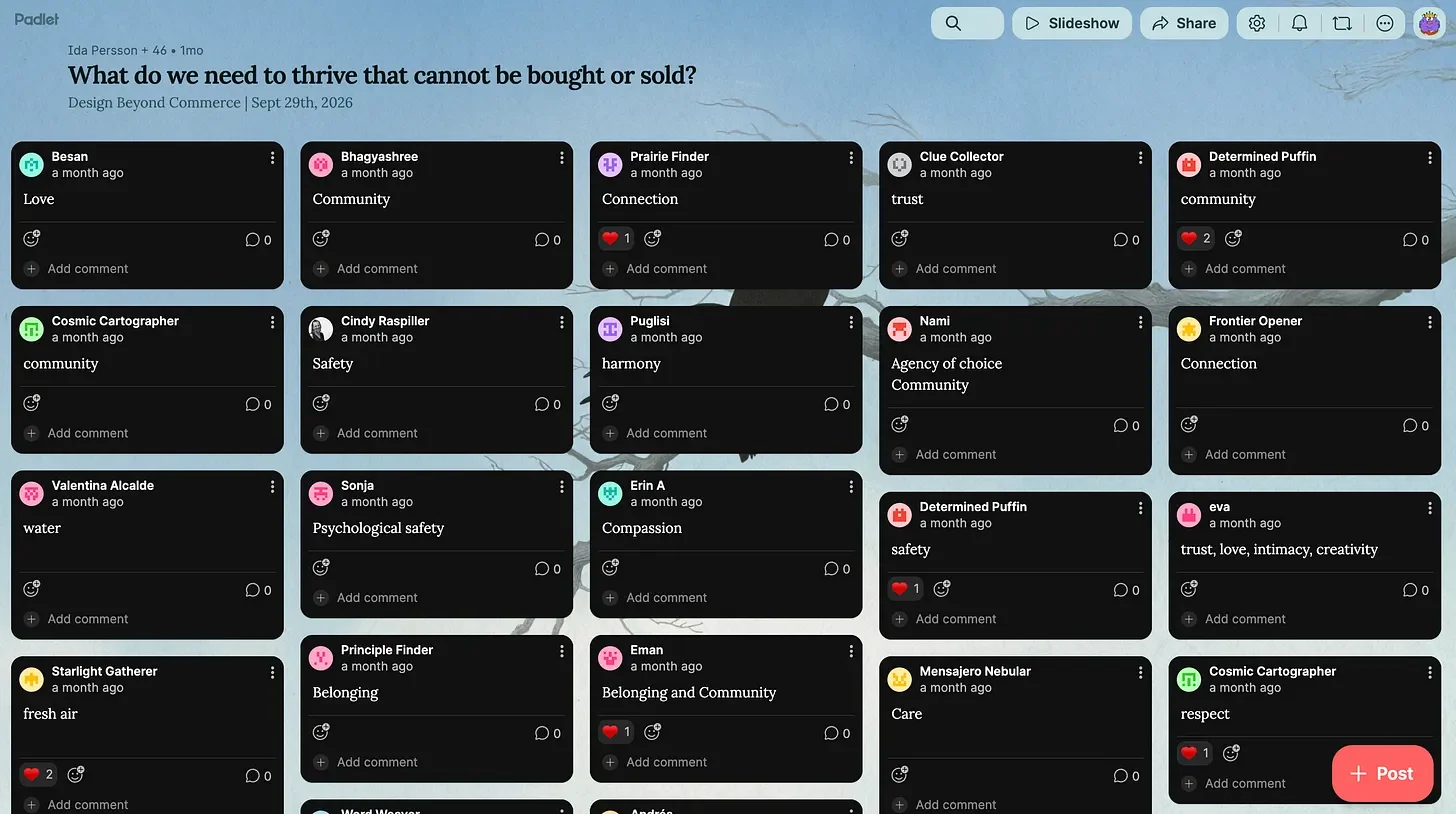
We started by asking: What do we need to thrive that cannot be bought or sold?
The reflection brought up many provocations and discussions. Things like trust, community, love, belonging were rose to the surface many times. We also touched on play, experimentation, and confidence.
the second part of the experience was to start designing beyond commerce. Each participant was asked to think about how we could design for Care, Community, Craft, Culture, or Contentment. The question we asked:
From Commerce to Care: What parts of relationships can be optimized, and what parts need time, attention, and presence? How do we design for these moments of attention?
From Commerce to Community: What would we design differently if belonging and mutual support mattered more than individual consumption?
From Commerce to Craft: How would we create differently if quality, repair, and longevity mattered more than speed, scale, and novelty?
From Commerce to Culture: How can design preserve, express, and evolve culture instead of homogenizing it for markets?
From Commerce to Contentment: What could we design if the goal was to help people feel that they have enough, rather than create another reason to want more?
People provided ideas in Figma and the synthesis pointed to 5 overarching themes for what it means to Design Beyond Commerce:
Spaces and infrastructures: Creating the physical and social conditions for different ways of living.
Relationships and reciprocity: Strengthening connection, mutual support, and responsibility.
Skills and capacities: Rebuilding practical, relational, and collective capabilities.
Time and attention: Making room for slowness, presence, process, and care.
Values and worldviews: Changing what we consider valuable, desirable, and worth pursuing.
Detailed Synthesis
From Commerce to Care: From efficiency and transactions to attention, reciprocity, and responsibility.
1. Spaces for connection
Creating intentional spaces for gathering, conversation, and shared experiences.
Bringing people together across generations, backgrounds, and differences.
Making room for unstructured time and simply being together.
2. Relationships beyond transactions
Encouraging everyday acts of connection, from handwritten letters to helping neighbours.
Making space for reciprocity, exchange, and mutual support.
Recognising connection beyond close relationships and friendships.
3. Time, presence, and attention
Protecting time for meaningful conversations, play, and shared experiences.
Creating opportunities to slow down and be present with ourselves and others.
Valuing the process of growth, healing, and relationship-building.
4. The capacity to care
Developing skills for conflict resolution, accountability, and repair.
Recognising the limits and capacities involved in caring for others.
Extending care beyond humans to the natural world.
From Commerce to Community: From individual consumption to collective capacity and mutual support.
1. Shared spaces and infrastructure
Creating accessible public spaces, libraries, community hubs, and gathering places.
Exploring cooperative housing and community-oriented urban planning.
Making shared resources and spaces easier to access.
2. Collective making and learning
Creating opportunities to cook, craft, learn, and make things together.
Encouraging intergenerational knowledge exchange.
Building collaborations between community spaces and organisations.
3. Mutual support and resource sharing
Strengthening practices of borrowing, bartering, and sharing.
Creating systems for mobilising resources collectively.
Building local networks of support and reciprocity.
4. Participation and distributed agency
Recognising everyone as a potential designer and contributor.
Designing with communities rather than for them.
Moving beyond professional hierarchies and creating more participatory processes.
From Commerce to Craft: From speed, scale, and disposability to skill, quality, and longevity.
1. Making things to last
Designing for durability, repair, reuse, and adaptability.
Challenging planned obsolescence and disposable production.
Prioritising material quality over cheap and quick alternatives.
2. Local production and material knowledge
Working with local materials, makers, and skills.
Reconnecting production with the places and communities it affects.
Supporting local production and responsibility across the full lifecycle.
3. Repair, reuse, and circularity
Building infrastructure for repair, borrowing, refilling, and upcycling.
Designing for materials to return to natural cycles.
Taking responsibility for waste and the consequences of production.
4. Learning through making
Bringing craft and practical skills into education.
Valuing the knowledge and time involved in making.
Reconnecting people with the processes behind the things they use.
From Commerce to Culture: From homogenization and global sameness to difference, specificity, and rootedness.
1. Rootedness in place
Designing with local histories, cultures, materials, and landscapes.
Building stronger relationships with the places we inhabit.
Recognising the more-than-human life that shapes a place.
2. Cultural plurality and exchange
Making space for different worldviews, experiences, and perspectives.
Learning from cultures beyond dominant Western narratives.
Creating opportunities for cultural exchange and empathy.
3. Expression and creative freedom
Encouraging more experimentation, creative practice, and personal expression.
Allowing serendipity, chance, and unexpected connections to emerge.
Making room for cultural specificity rather than designing for universal appeal.
4. Values over persuasion
Designing around shared values and lived experiences.
Moving away from creating artificial needs and desires.
Recognising that meaningful cultural expression often exists beyond design itself.
From Commerce to Contentment: From endless appetite and manufactured scarcity to sufficiency, appreciation, and enoughness.
1. Redefining enough
Challenging the assumption that more is always better.
Exploring sufficiency as an alternative to endless growth and consumption.
Recognising that enough must begin with meeting everyone's essential needs.
2. Appreciating what we have
Creating practices around gratitude, reflection, and appreciation.
Making space to recognise the value of existing relationships, resources, and experiences.
Encouraging shared activities that create meaning without requiring more consumption.
3. Reconnecting with ourselves
Creating opportunities to pause and attune to our bodies and needs.
Encouraging mindfulness and awareness of what genuinely brings fulfilment.
Shifting attention away from external desires towards inner experience.
4. Sharing abundance
Designing ways to redistribute and share existing resources.
Strengthening collective resource mobilisation and mutual support.
Recognising abundance as something that can be created through relationships and shared resources.
5. Changing the systems of desire
Rethinking marketing and communication beyond creating new wants.
Designing systems that reward restraint, mindfulness, and sufficiency.
Moving away from incentives built around excess and overconsumption.
What’s next?
This session was the beginning of a larger exploration into the topic. A different world is possible and this session shows that we’re already thinking about and building the ideas that support a different future.
Want to chat more about this? Send me an email
