
DesignShift: From Answers to Questions
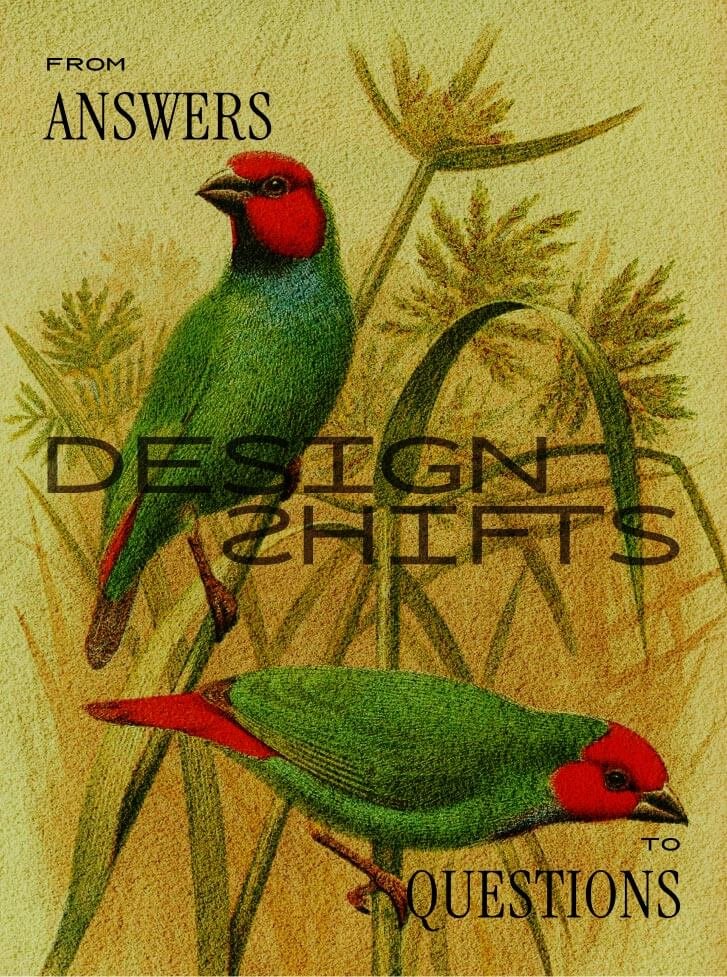
Instead of seeing design as a tool to reach a destination (to find an answer), could it be an invitation for movement and exploration?
How many times have you been in a conversation that started with a question and ended with: “Huh, I don’t know the answer. Let me Google that (or ask ChatGPT).” We grab our phones, find an answer, and feeling like we’ve gotten what we needed, it’s the end of the discussion. Next topic. Moving on.
The internet has given us unlimited access to information. The answers to nearly every question we could imagine are literally at our fingertips. But often, what we truly need is not answers, but rather space to talk, explore, and have meaningful conversations with others.
The internet and many well-designed tools and products pride themselves on providing solutions. I’ve called myself a “problem-solver” many times—partly to demonstrate the value of design and partly to explain that what I do goes beyond making pretty things. Design is strategic and helps reach business objectives.
However, lately, I’ve been reflecting on how this focus on finding answers and “fixing” problems can limit us from exploring possibilities beyond our wildest imaginations.
The problem with answers…
Some questions, like “Where is the nearest coffee shop?” or “What’s the current price of gasoline,” are relatively straightforward. As humans, we’ve become aware of the algorithms at play, and when searching for these answers, we can evaluate search results objectively and decide which ones to use without much internal conflict. These questions are often tension-free, and searching yields reasonably acceptable answers.
However, bigger questions like “How do we solve poverty?” or “How do we battle climate change?” introduce complexity to our search. These are what we call “Wicked Problems.”
The term Wicked Problem was coined by Horst Rittel, a design theorist and professor of design methodology at the Ulm School of Design, Germany. Wikipedia describes a wicked problem as “a problem that is difficult or impossible to solve because of incomplete, contradictory, and changing requirements that are often difficult to recognize. It refers to an idea or problem that cannot be fixed, where there is no single solution to the problem; and ‘wicked’ denotes resistance to resolution, rather than evil.”
In essence, these are complex, systemic problems that require a systemic lens and collaboration across different beliefs and opinions. But in a world that moves faster every day, we’re conditioned to want quick answers without deep thinking or genuine collaboration.
With tools like Google or ChatGPT, we no longer take the time to talk things through and connect on a human level. Our discussions become debates where each side uses their online sources to support their own truth. Soon, we’re trapped in an “us versus them” mentality, and conversations become about winning rather than understanding all perspectives.
In the course We Will Dance With Mountains: VUNJA! produced by For the Wild, Bayo Akomolafe discusses the limitations of answers. He says, “It is often the case that the answer to a question preserves the economy of relations that gave birth to the problem in the first place.” He continues, “What would be more exquisite than an answer to a question? Bewilderment.” We need to acknowledge that the answers that come quickly to us are often based on the preexisting conditions we’re trying to move away from. Answers do this. We need to be willing to dance with the unknown and be with the questions.
Thanks for reading DesignShifts! Subscribe for free to receive new posts and support my work.
DesignShift: From answers to questions.
These inquiries guide my desire to move from answers to questions in my design practice. Lately, I’ve been asking myself:
Instead of seeing design as a tool to reach a destination (to find an answer or solve a problem), could it be an invitation for movement and exploration?
How can we ask questions that are less about narrowing down to a fixed spot, and more about expanding beyond our wildest imaginations and our deepest roots?
How can we embrace questions that encourage imagination, curiosity, and criticality?
In the book Hospicing Modernity, Vanessa Machado de Oliveira asks: “How might our desire to ‘fix’ and ‘solve’ limit what global social change we might imagine as possible?” She also asks: “How do we shift the action-oriented tendencies that currently dominate in education and social change discourses away from fixed horizons of certainty, and toward engaging with what is viable yet unimaginable?”
I invite you to embrace these questions and other as a way to explore new possibilities. Capitalism often limits us to questions like “what, how soon, how much?” (as explored in this episode from “On Being”). We are very comfortable with these kinds of questions.
The invitation: A new kind of questioning
I encourage you to open your heart and mind to a different kind of questioning. Questions that encourage imagination, curiosity, and criticality. Questions that are less about narrowing down to a fixed spot and more about expanding beyond our wildest imaginations and our deepest roots. Questions like: why, to what effect, how much is enough? Questions that invite movement and exploration.
What some of those questions might look like:
From “what do you do for a living?” to “what makes you come alive?”
What are you?” to “How are you becoming?”
From “Where do you belong?” to “How are you arriving?”
Engage with questions as a tool to spark thoughts, examine tensions, and hopefully invite you to expand your mind, heart, soul, and relationships to others.
A piece of art from For the wild
When you encounter questions or statements that confuse or trigger you, sit with them. Feel them move through your body like waves of curiosity. Talk to someone else about them. Share the tensions you feel.
As we move through our lives, rather than focusing solely on resolutions or answers, make space for questions. There is so much that is unknown. And there is so much that is unknowable. And so many possibilities can be found in being with questions.
A practice:
In this On Being Episode, Krista Tippett shares shares an exercise that helps us embrace questions:
“Formulate a question that is rolling around in your life or in that boundary between what is personal and what is public or civilizational. Write it down, hone it, and make a commitment to it. Commit to having it over your shoulder, in your ear, as you move through your life. See what it invites you to see and to move towards and to move away from. I would start by writing this down and giving it a month, or giving it a year.”
