DesignShift: From Force to Flow

A panting of an ocean and the text "from force to flow"

What can water teach us about navigating uncertainty?


I’ve always loved water. I started swimming when I was 7 and didn’t stop until I was 27. Twenty years of early morning and late nights mostly under the surface. Swimming taught me the strength and softness of water, and more than anything, I think it taught me the rhythms of seasons.

Every athlete knows that you can’t run far, swim fast, or jump high all the time. You have periods to rest, and you have periods to race. In swimming, I had one BIG race for the year. National championships, college competitions, or important qualification meets. This was our time to swim fast. In athletics, it’s easy to accept that we have peak competitions where we’re supposed to be at our best. But between those peaks, we have slower seasons focused on building, recovering, and reassessing.

Swimming taught me that we rest in order to race. But it also showed me that all seasons matter equally. Some are for rest, others for rehab and recovery, and then of course, the seasons for racing and reward.

Even though swimming showed me the beauty of the seasons, when I entered the work force, it seemed like I was entering a world that was always in race mode. The rushing to get things done didn’t seem to pause for reflection. There was no seasons for slowness, and no schedules showed me when I was allowed to take a break (beyond lunch and holidays)

In every job posting I see, we’re asked to “thrive in fast-paced environments” but I have yet to meet a person who truly thrives in environments where they’re always running. Most people can thrive (or manage, maybe that’s a better word) in a fast-paced environment for a shorter period of time. But after a while, they too need to rest and recover.


From Force to Flow: A Framework for Navigating Change
As I’ve been reflecting on swimming and my work experience, I’ve been thinking about the many states of water as a guide to meeting the moment we’re in. What would it look like to embrace flow instead of force?

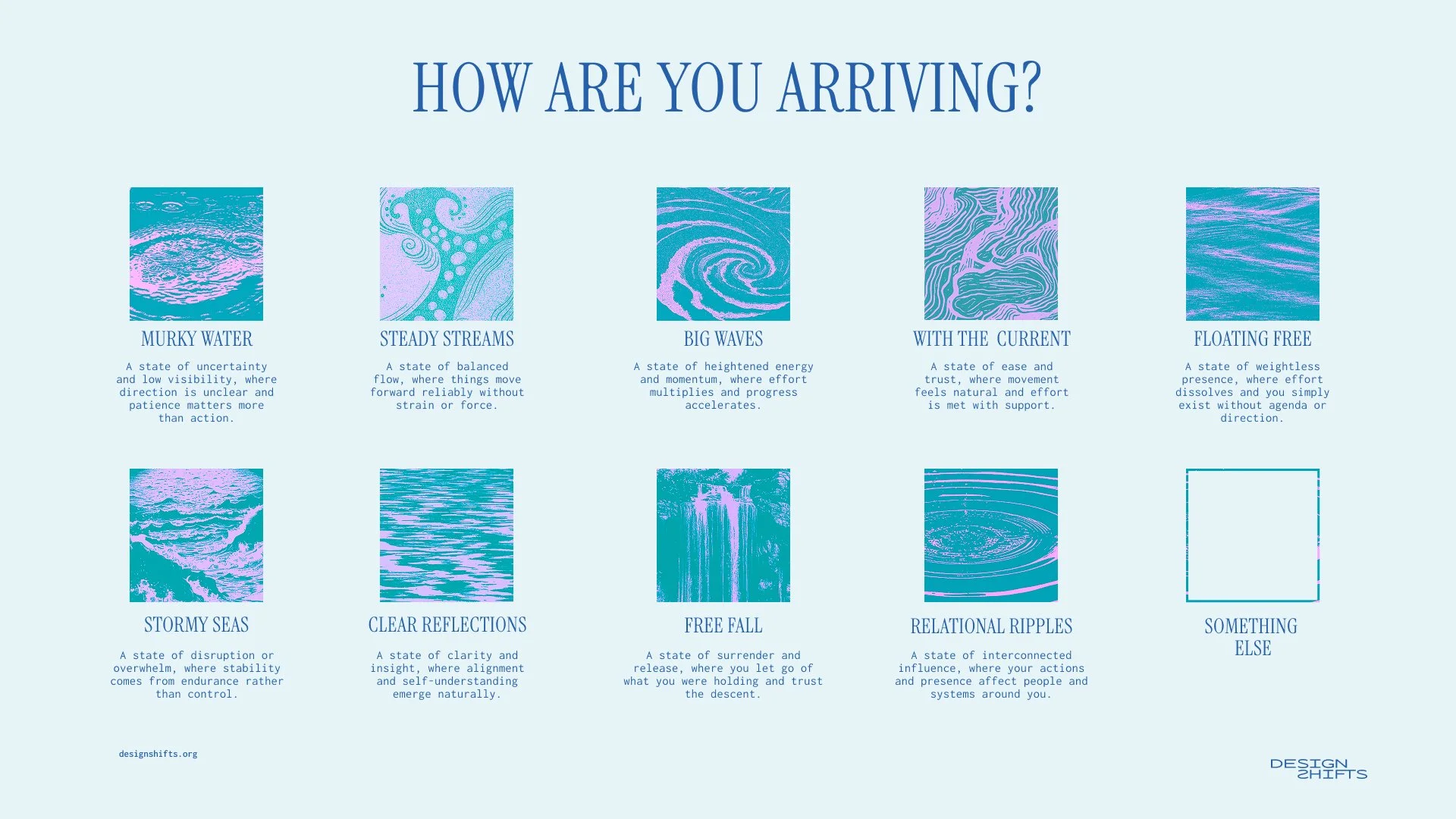
Below are 9 states of flow that invites you (and me) to embrace water as a tool for accepting the phase we’re in. Instead of trying to calm the ocean or rush toward clarity, we practice recognizing the state we’re in and finding ways to respond to it with care. Sometimes the water is murky. Sometimes it’s stormy. Sometimes it’s a quiet ripple. Each state carries meaning. Each state offers guidance. Each state of water reflects a different relationship to energy, clarity, and motion.

How to use this framework

  1. Notice your water. Take a moment to feel your current state (the states below is a guide but free to to think of others too).

  2. Name it. Identify which state best fits your experience.

  3. Choose your rhythm. Ask: What action, rest, or reflection matches this state?

  4. Move with it. Align effort and attention to your current state, without forcing.

  5. Trust the cycle. Flow includes all states. This one will pass, and another will follow.

Murky Water

A state of uncertainty and low visibility, where direction is unclear and patience matters more than action. Pause and reduce noise. Let clarity settle on its own. Resist the urge to force decisions or outcomes.

abstract water image

Steady Streams

A state of balanced flow, where things move forward reliably without strain or force. Maintain rhythm. Keep progress steady without overcomplicating or overdoing.

Big Waves

A state of heightened energy and momentum, where effort multiplies and progress accelerates. Commit fully. Use the energy while it’s here. Take bold action without losing presence.

With the Current

A state of ease and trust, where movement feels natural and effort is met with support. Receive the ride. Stay present. Allow momentum to carry you without forcing it

Floating Free

A state of weightless presence, where effort dissolves and you simply exist without agenda or direction. Rest without purpose. Be held by the water. Let buoyancy do the work while you remember what it feels like to just be.

Stormy Seas

A state of disruption or overwhelm, where stability comes from endurance rather than control. Prioritize safety, rest, and recovery. Endurance matters more than productivity. Let the storm move through you.

Clear Reflections

A state of clarity and insight, where alignment and self-understanding emerge naturally. Observe carefully. Adjust gently. Translate insight into thoughtful action.

Free Fall

A state of surrender and release, where you let go of what you were holding and trust the descent. Stop grasping. Allow the fall. Trust that you will land differently than you left, and that’s exactly what needs to happen.

Relational Ripples

A state of interconnected influence, where your actions and presence affect people and systems around you. Notice how you move others and how they move you.Your impact is both more subtle and more significant than you think.

Being and becoming

At work, I kept trying to force myself into the water I thought I should be in, pushing for clarity when I was foggy, demanding productivity when I was depleted, apologizing for needing rest. In swimming, I learned to pay attention to how the water was flowing and when fighting against it made things worse.

Now I’m trying to stay with the actual state, without fighting the wave, without rushing toward clearer water, without romanticizing rest or intensity. It’s about recognizing that the same intelligence that guided me through seasons of training can guide me through seasons of work and life. Not by controlling the water, but by learning to move with it.

Next
Next

DesignShift: Shifting Within and Shifting Beyond