
DesignShift: From Frictionless to Frictionful
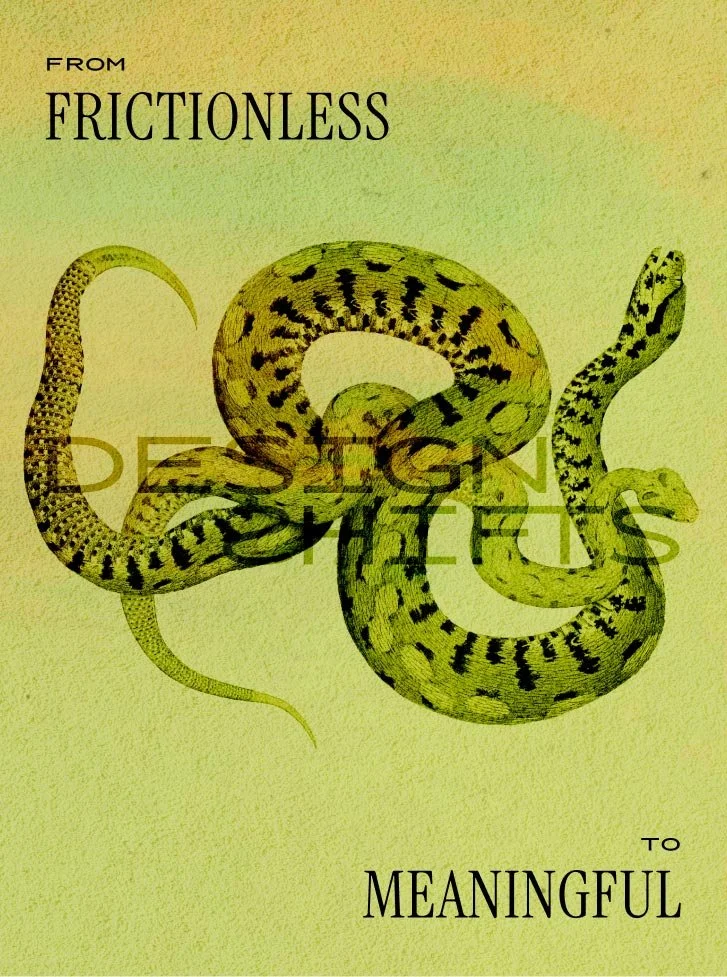
Good design is frictionless, right?
Designers quickly learn that friction = bad. We spend most of our time trying to remove friction in order improve experiences. However, is this desire for — or should I say obsession with — frictionlessness always a good thing?
Good design is frictionless, right? When a product seamlessly fits into our lives, when a digital experience is smooth and without problems, that is what we call successful design. It’s when we experience friction with a product that we start to pay attention. A Slack outage. A phone where the user interface makes it hard to find the call button. A shirt that, despite its promise, doesn’t protect against the ice-cold wind. A designer’s goal and dream are to create frictionless experiences that just work.
Designers quickly learn that friction = bad and then we spend most of our time trying to remove friction in order to improve experiences.
However, is this desire for, or obsession with, frictionlessness always a good thing? Can friction actually enrich experiences?
During a recent hike up a mountain in Germany, my friend and designer Molly and I started talking about friction and design. The topic came up as we were struggling to catch our breath with the increasing elevation. Molly explained that:
“We spend so much time making things frictionless, but by making it frictionless we make it forgettable.”
DesignShift: From Frictionless to Meaningful
Molly’s reflection made me consider the many ways that frictionless often means meaningless and the many ways that we can benefit from more friction in our lives.
These are the emerging ways that friction brings meaning to our lives:
Friction creates memorable experiences
Friction invites reflection
Friction invites responsibility
Friction raises awareness
Friction helps us connect with other people
Friction helps us consume less
Friction enables learning
Friction helps us do hard things
1. Friction creates memorable experiences
The first topic I want to explore is the idea that Molly expressed during our hike: “We spend so much time making things frictionless, but by making it frictionless we make it forgettable.”
Think about the most memorable experiences of your life. Chances are, they weren’t the times when everything went smoothly. They were the moments filled with challenge, effort, and yes—friction. The hike where you got lost but discovered a hidden waterfall. The meal you struggled to cook but finally perfected. The project that pushed you to your limits but resulted in work you’re truly proud of.
There’s also what researchers call the effort heuristic. It is our tendency to value things more when we’ve put effort into them. When we struggle through something, overcome obstacles, and finally succeed, the achievement feels more significant. IKEA famously benefits from this with the “IKEA effect”—people value furniture more when they’ve assembled it themselves, despite the frustration of deciphering instruction manuals and searching for missing screws. The friction of assembly creates attachment and memory.
2. Friction invites reflection: Make Me Think
One of the most popular books in design is Don’t Make Me Think by Steve Krug. It’s a practical guide to making websites and digital interfaces easy to use. Krug emphasizes that users should be able to navigate and interact with a site without having to stop and think. He encourages designers to focus on clarity, simplicity, and usability by following familiar design conventions, minimizing distractions, and making key actions obvious.
It’s a book about creating good user experiences, and while it provides a lot of valuable tips for designers, it also creates a false narrative that less friction is always good.
Let’s look at an example from the world of e-commerce. In this space, we often see the strategy of reduced friction as a way for companies to sell more products people might not actually need. On the website KindCommerce created by friend and co-creator Anna Rátkai, she explains how “Companies use buy-now buttons instead of add-to-cart to reduce friction in the checkout and generate more impulse purchases.” Consumers experience frictionlessness. It might feel nice in the moment, but often has long-term consequences. Impulsive decisions often lead to overspending while causing additional harm to our already hurting planet.
Making people think by adding friction can help people stop buying things they don’t really need. It can help them reflect on their actions before taking them.
3. Friction invites responsibility
A lot of designers have good intentions. We want to create work that helps people. We want to make sure that our work does not cause harm. However, caught between compressed timelines and budget cuts, we’re forced to take shortcuts and those shortcuts can have unintended negative consequences. As I was exploring the idea of friction as a catalyst for good, I also started thinking about how we can use friction or moments of pausing in order to hold ourselves accountable.
When I worked at IDEO, we worked on innovation projects that lasted around 12 weeks. We went through the design thinking process in order to create new and innovative solutions for our clients. The process was fast; we worked long nights and weekends in order to have something to present to the clients. There was not a lot of time for reflection. There was not time to stop and say: wait a minute, what are we missing?
In the tech industry, we celebrate speed. “Move fast and break things” was Facebook’s motto for years. But what gets broken in that rush? Often, it’s the careful consideration of consequences. When we optimize for frictionless development processes, we skip the uncomfortable questions: Who might this harm? What are we not considering? Whose voices are missing from this room?
I believe that “Good design is a dance between curiosity AND criticality.” In design thinking, we use the question “how might we” to encourage opportunities through curiosity. As often as we ask “how might we” we also have to ask “at what cost”.
4. Friction raises awareness
If you’ve ever had a Tony’s Chocolonely bar before, you’ve probably noticed that the pieces are different from what you’re used to seeing. Rather than perfectly straight and easy-to-break-off rows, the pieces are uneven. Some are big and others are small. The unevenness makes it hard to break the pieces off. The company has gotten a lot of complaints from customers about the pieces. Most people find them hard to break off. The unevenness creates friction for customers just looking to enjoy a piece of chocolate.
However, there is a story to the friction. In the FAQs on their website, they write:
“To us it doesn’t make sense for chocolate bars to be divided into chunks of equal sizes when there is so much inequality in the chocolate industry! The unevenly sized chunks of our 6oz bars are a palatable way of reminding our choco friends that the profits in the chocolate industry are unfairly divided.”
Today, the majority of cocoa farming is done in West Africa with farmers earning as little as 78 cents per day — well below the World Bank’s extreme poverty line of $1.90 per day. Child labor is a major problem with an estimate of 1.56 million children currently working in cocoa farming.
The uneven pieces represent this inequality and how Tony’s Chocolonely is trying to change this one uneven piece at a time. The friction within the product creates an opportunity for Tony’s to raise awareness and highlight how their product stands for more than taste and form. The friction creates an opportunity to connect with customers. Some might have bought the chocolate just because it tastes good or because of the pretty packaging, but Tony’s is not just looking to sell another chocolate bar. They want to create friction in the industry in order to create systematic change.
5. Friction helps us connect with other people
We live frictionless lives that promise ease, but somehow, loneliness is on the rise.
When I started working on the DesignShifts, I wanted to explore the shift “From convenience to connection.” This topic relates closely to our practices in design, but I also realized that when we talk about frictionless, most of the time we’re also talking about convenience. Our solutions are meant to make life simpler, to optimize experiences. To help us get from A to B quicker. Convenience often equals frictionless.
Kyla Scanlon reflects on how many of our digital experiences provide an escape from the real world which often has a lot of friction. Dating apps, curated social media feeds, instantly translating headphones, and food delivered at the push of a button are easy to turn to when the real world feels challenging.
Optimized, convenient, and frictionless experiences often mean that human connections are removed. Because human interactions increase the likelihood for friction. We have apps that make it easier to order food without any human interactions. This might feel nice in the moment, but it might also lead to increased isolation and disconnection.
The unintended consequences of convenience are that we’re becoming less connected to our communities. The design solutions are making it easy to avoid human interactions.
6. Friction makes us consume less
Two years ago, I decided to stop shopping at Amazon. The convenience of the platform had kept me hooked for a long time, but I also kept seeing stories about their inhumane work conditions, strategies to outprice all independent local bookstores, and the ever-growing wealth of Jeff Bezos. These issues kept nagging me so one day, I decided to stop using their service.
My decision added a lot of friction. When I needed supplies to fix tiles in my bathroom, my free Amazon next-day delivery was replaced with a 20-minute bike ride through the city, 20 minutes of searching a large hardware store with the help of a shop assistant, only to arrive home noticing I’d picked up the wrong color. The experience was quite frustrating and took a lot of time and energy. However, not shopping at Amazon made me aware of all the things I bought “just because.” When I needed something small for my house, I always ended up buying additional things—both to get free shipping, but also because I might need this later. When I stopped using Amazon, I stopped shopping as much. The friction led me to reconsider many purchases. The friction led me to not buy extra things I did not need.
7. Friction enables learning
Many times in my career and life I’ve thought to myself “I wish I could just click a button and I would know all this already.” I often feel this way with my slow-moving German language progress. Wouldn’t it be nice to have a magic button that took us to the finish line right away? Or better yet, would it be better if someone else could do the task for us?
Our brains are wired to remember things that require effort. Cognitive psychology shows us that information processed with more difficulty is often retained better—a phenomenon known as desirable difficulty. When we remove all friction from an experience, we also remove the cognitive engagement that helps us form lasting memories. Yes, sometimes I wish that my German would be perfect already. I wish that I could skip the pain of the process. However, learning isn’t just in service of an end product. Learning is also in service of expansion of minds, hearts, and souls. Learning is in service of stronger connections. Learning is in service of living. When we learn, we expand and that’s what life is about.
A Reflection
Just because we have calculators, doesn’t mean we don’t need to understand math.
Just because we can auto-generate art, doesn’t mean we shouldn’t create a painting.
Just because we can summarize a book in seconds, doesn’t mean it’s not worth reading the full story.
Just because we can buy food at the store, doesn’t mean we shouldn’t learn about how our food is grown.
Just because AI can do a task for us, doesn’t mean it’s not worth learning.
AI might know everything and be able to do everything. Just because we could skip the learning (which is living), doesn’t mean we should.
8. Friction helps us do MORE hard things
I want to end where we started: alongside Molly in the German mountains. During that hike Molly also said that: “When you learn that you can handle some friction, you realize you can handle even more. By always trying to reduce even small amounts of friction, we take away our own power to handle hard things.”
We’ve been removed from pressure. However, frictionless experiences limit our ability to do hard things in the future. Psychologist Michael Inzlicht at the University of Toronto has studied what he calls the “effort paradox”: while humans naturally avoid effort, engaging in challenging activities often leads to a deeper sense of meaning and personal growth. In an episode of the Hidden Brain podcast, Inzlicht explains that effort is inherently meaningful, and activities requiring more exertion paradoxically become more satisfying and purposeful.
When we constantly optimize for ease and eliminate friction from our experiences, we rob ourselves of the capacity to build mental and physical resilience. Like muscles that atrophy without use, our ability to handle difficulty weakens when we never practice it.
This has profound implications for how we design our lives and products. Each time we remove a small friction (autoplay that removes the choice to continue watching, one-click purchasing that bypasses reflection, AI that completes our thoughts before we’ve fully formed them) we’re not just making life easier. We’re also reducing our tolerance for challenge and diminishing our sense of capability.
Ending the year of the Snake
As we soon leave the year of the snake, I want to take a moment to reflect on this piece that Lilian Marino wrote as the year of the snake started. In it, she writes “Snakes need friction to move forward. They press against surfaces, grip, and even shift their own scales to generate traction. Without friction, they’re stuck.”
What if we designed friction into our lives in order to create memorable moments, think and reflect, become aware, take responsibility, connect, learn, and do Heard things.
When I think about all the benefits of friction, I also think of it as the path forward. Friction as a path forward fills me with a sense of empowerment. This year, I want to use friction as a tool to move away from ease, speed, and invisibility towards awareness, reflection, and transparency.
