
DesignShift: From Performing to Process
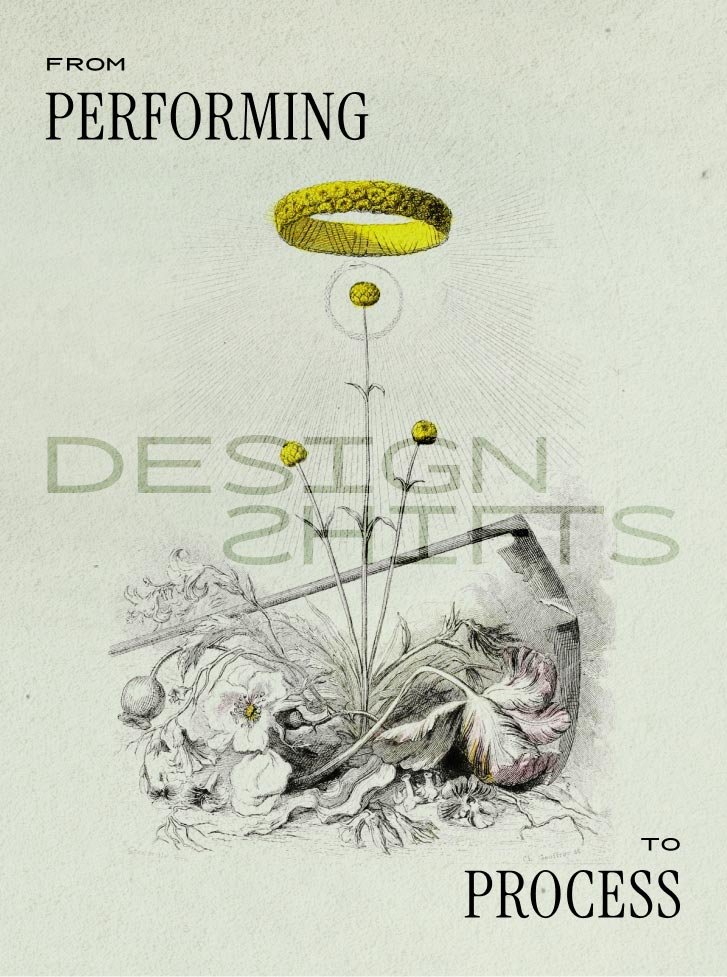
If creativity becomes about clicking a button to turn our work into reality, haven’t we lost what creating is all about?
“Life is about the journey. Not the outcome.” A somewhat cliché but also true statement that can be applied to both life and the work we do as creatives. “Creativity is about the journey. Not the outcome.”
But in a world that tells us to produce MORE and faster, the journey often takes a backseat to endless production in order to stay relevant. It is estimated that 90% of the world’s data was generated in the last two years alone (the numbers have most likely changed by the time this is published) and I can’t help but wonder… Is the speed of our industry forcing us to let go of the process and focus solely on the road to least resistance?
For the last 15 years, I’ve been working as a commercial designer. I’ve held many titles. I’ve designed websites, made videos, and crafted digital user-experiences. I’ve worked in advertising, design, and consultancy. And I’ve been working really hard. As a former semi-professional swimmer, “giving it my all” is ingrained in my bones, and the industries of advertising, design, and consultancies have been purposefully designed to take advantage of the Type-A drives of people like me — all in pursuit of defining “next big thing.”
A while ago, I heard someone say that they wish that they could just click a button and their idea would come to life. They were saying how much they like that this is now possible with Ai.
I remember thinking that this person is either overworked or does not like the creative process. If creativity becomes about clicking a button to turn our work into reality, haven’t we lost what creating is all about? The process of bringing something to life… The trial and errors. If want to skip the making part of “making” something, do we really want to make or do we just want to make it?
Thanks for reading DesignShifts! Subscribe for free to receive new posts and support my work.
Making or making it
“There are people who create shit. And then these people are thrown into an environment and an industry where they’re chasing how many views you have, how many comments.” - Tim Bergling (Avicii)
This quote comes from the documentary “I’m Tim,” Tim Bergling, artist name Avicii. Tim was one of those artists who just wanted to create for the joy of creating. He was sensitive and intuitive. He was pure in his passion for his work. But along the way, the industry swallowed him up. His mental health started to decline and the pressure to produce for the sake of producing became hard for him to handle. It seemed like his work became more about doing work that pleased the industry rather than the work that lived inside of him. Like many other creative professionals, his vision was at odds with the industry.
Tim died in the middle of his successful career in 2018. In the documentary, you get to see how industry professionals pushed back when he wanted to try something new. The industry didn’t care about his creativity. It didn’t care about HOW he made his work. The industry only cared about clicks, likes, and responses. When Tim was doing well, his manager and record company praised him. When he chose to take a risk and lean into his process and intuitions, the response was the opposite.
But, what happens to us artists, writers, and designers when we lose the process? When work becomes all about the performance and product? Is that where learning stops? Is that where the joy is diminished?
DesignShift: From performing to process through presence.
One morning last year, I was journaling. It’s a routine similar to the famous Morning Pages from the book The Artist’s Way by author Julia Cameron. I just write whatever comes out, without a goal in mind. It’s incredibly freeing in so many ways, yet I often find myself stopping and thinking, “what if someone reads this?” “What if what I am writing does not make sense?” Cameron would tell me that that is exactly the point of Morning Pages. Morning Pages do not have to make sense.
The benefit is in the making. And that is when it all hit me… the benefit is in the processes, but the performance.
When we write for ourselves, we write differently. When we know that no one is watching us. When there’s no one waiting to evaluate or judge our work. When we’re not creating for an audience, the words flow differently. When we’re not focusing on what to post or what will resonate, we free ourselves and we open ourselves up to creativity. The process becomes the focus. Not the output.
The Telic vs. Atelic way of showing up
When we let go of the outcome, something in us shifts. We become free to move with the flow and embrace what is rather than what we hope to be. I love what figure skater Alysa Liu said after winning at the 2026 Winter Olympics: “winning isn’t all that. And neither is losing. It’s just something that happens. It’s the outcome. What matters is the input and the journey.” She speaks as an athlete but also as a creative who values the creative process itself. And I think that mentality allows her to enjoy her wins more deeply than someone who puts all their focus on the outcome rather than the experience of becoming.
As I was researching this post and admiring Liu’s mindset, I came across the distinction between Telic and Atelic mindsets. A telic orientation is goal-driven. It is about reaching an endpoint. Success is defined by completion, achievement, arrival. The project is valuable because of what it produces.
An Atelic orientation, on the other hand, is process-driven. It has no fixed endpoint. Its value lies in the doing itself. Think of walking, dancing, playing, conversing, learning. These are not activities that “finish” in the same way a task does. They are ongoing. The meaning is embedded in the participation.
This post is about an Atelic way of approaching our work. This does not mean abandoning goals. It means loosening our grip on them. Letting process shape us rather than forcing ourselves toward a fixed image of success. When we shift from performance to process, we shift from being obsessed with final deliverables to becoming devoted to the quality of our engagement.
Alysa Liu also said “I connect with everything, but I’m not attached to anything.” Not being attached to outcomes opens up space for true freedom. It allows us to care deeply without being consumed. To strive without tightening. To create without fear.
Finding Our Way Back
When we recenter process, we remember that creativity is not a race to the finish line but a practice of showing up. It’s about building a relationship with uncertainty, developing comfort with not knowing where we’re headed, and trusting that the act of making will teach us what we need to know. Yes, AI can tell us what a book is about or even write a book for us. We don’t have to take the time to read or write. But what about the benefits of reading or writing? What about the things we learn along the way, or the joy we experience when reading or writing? AI can make beautiful illustrations… but as designers, we’re left without the happy accidents and the learning as we go. In a way, Midjourney takes away the journey.
To honor the process means giving ourselves time to metabolize experience. Time to reflect before reacting. Time to let meaning emerge rather than forcing it into form.
Because in the end, the work that matters most isn’t the work that performs best. It’s the work that transforms us in the making of it. It’s the work that teaches us something we didn’t know before we began. It’s the work that connects us more deeply to ourselves and to others.
At the end of the Barbie Movie, Barbie says:
“I want to do the imagining. I don’t want to BE the idea.”
And maybe that is it.
Both as a human and as a designer, I want to be part of the imagining. I want to enjoy (and struggle with) the journey, not just get credit for the outcome.
