
DesignShift Community Session: From Fixed Roles to Fluid Responses
In April 2026, we hosted a special edition DesignShifts event in collaboration with Culture First Manila and Jen Horn and it was all about how we can move from Fixed Roles to Fluid Identities. It was a community conversation on rethinking our roles and approaches in designing towards more connected and hopeful futures.
This session is hosted by Jen Horn of Culture First Manila in partnership with Design Center of the Philippines.
About the gathering
For generations, we have been taught to answer the question “What do you do?” with a single, clear label. Teacher. Engineer. Designer. Writer. Lawyer. These titles give us legitimacy, help us find work, and make our value easy to understand.
As designers, we often go further. We define ourselves by our outputs. I design apps. I create visual identities. I build systems. Our deliverables become shorthand for who we are.
But what happens when you are asked to navigate a world drowning in things, but starving for meaning? A world running low on resources. A world changing faster than our titles can follow.
Together, we:
examined the roles we currently hold
engaged emerging design archetypes as lenses for action.
explored how to move from static identities to responsive practice.
Reflections
The roles we hold and play
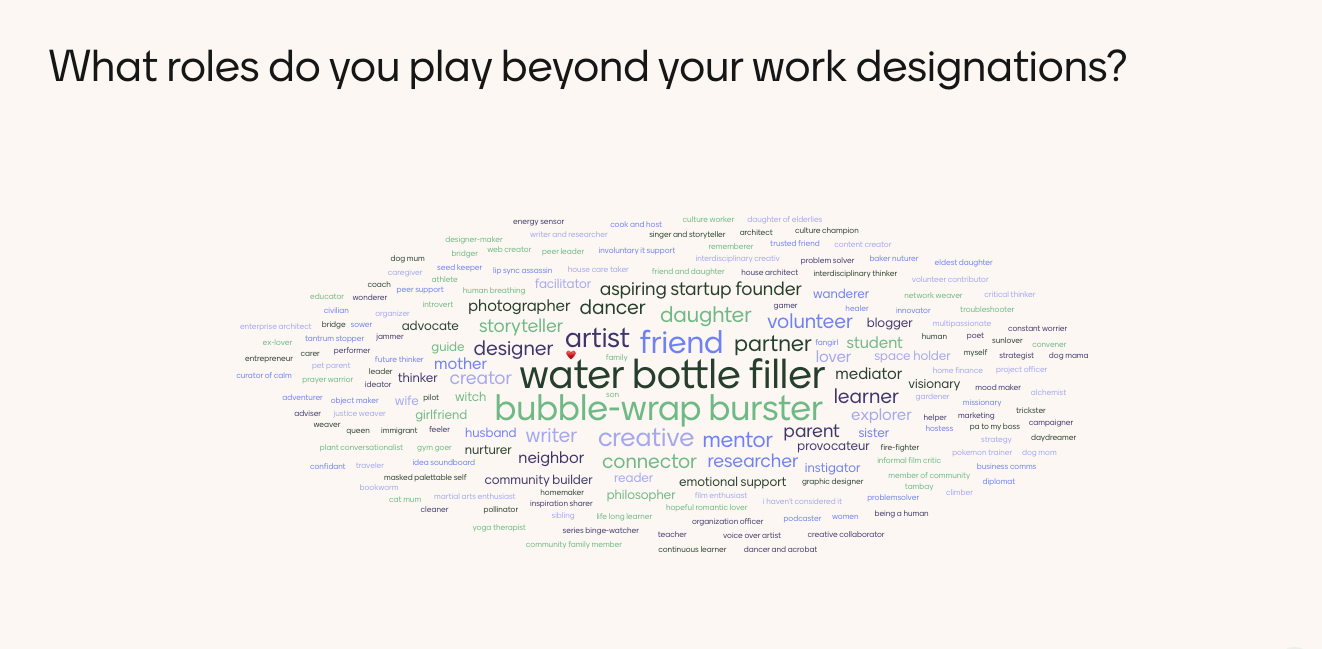
We started by examining our current roles. This meant answering questions about:
what roles we hold at work and
what roles we play beyond the professional space.
A few observations:
It was interesting to see the range of participants and the many roles we hold outside of our professional titles. “Waterbottle Filler” playfully surfaced as a top role we play outside of work.
Questions about work roles hit differently depending on where you find yourself professionally. For some, excitement and recent wins. For others, a reminder of what feels missing. Like when you’re between jobs and someone asks what you do.
The phrasing of the question also surfaced the tension between “playing a role” and embodying an identity (or practice). Because of the phrasing, some felt resistance adding personal traits like woman, lesbian, or mother, explaining that these traits feel more like identities they embody vs. a role they play. This reflection touches on the importance of questions that I wrote about recently. The questions we ask shape the answers we get, and part of DesignShifting is learning to ask more open, exploratory questions. One workshop participant explained that instead of asking about work roles they ask “What are you excited about these days?” or “What do you focus your attention on these days?”
New Responses for change: DesignShifters framework
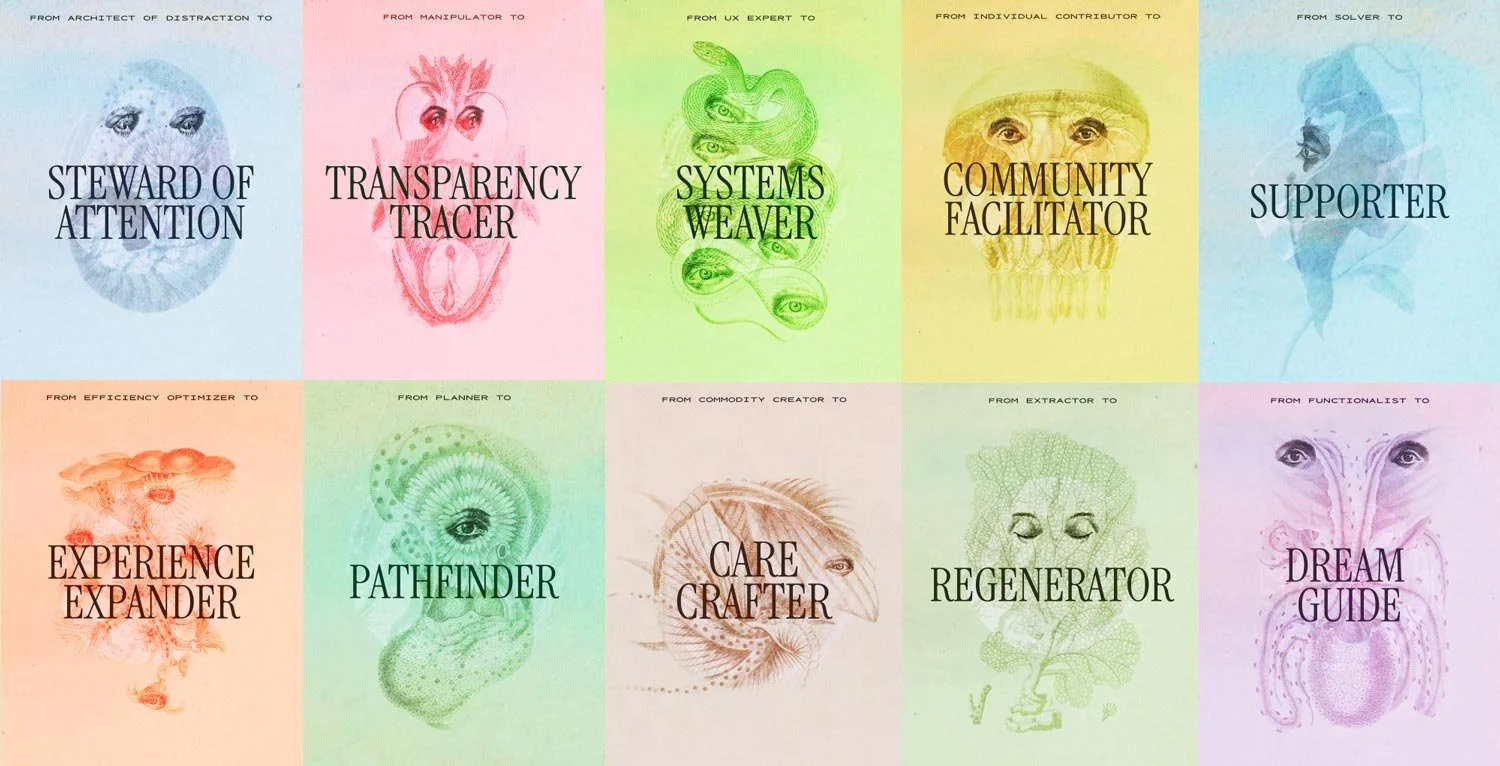
Most of the session was dedicated to the DesignShifter archetypes. We examined different responses through questions and found moments to see the overlaps, connections, and friction points.
One moment stood out: someone raised friction around the word “truth” in Truthteller. “I’m uncomfortable with “Truth” as a singular thing” they said. That observation led us to reflect on the subjectivity of truth and how One right way is one of the tenants of white supremacy culture.
After the session, I decided to rename the role to Transparency Tracer. Learning from the community is a big part of the work of DesignShifting. Since I started sharing these archetypes, a few of the words have been shifted and modified and I hope to continue evolving them together.
DesignShifter questions we explored together for each archetype:
From Architect of Distraction to Steward of Attention: How might I create spaces to connect more intentionally with myself and others?
From Manipulator to Transparency Tracer (originally Truth Teller): Who really benefits and who is disadvantaged by the current systems and structures we’re working in?
From UX Expert to System Weaver: What detrimental impacts might we unintentionally create when we ignore the system?
From Individual Contributor to Community Facilitator: How can we support communities to design the solutions they need?
From Solver to Supporter: What consistent practices and structures of care are needed to sustain support after a project ends?
How can we let go of outcomes and create experiences where we are truly present?
From Planner to Pathfinder: What openness and trust can I give to myself, those I work with, and the process, as we navigate change together?
From Commodity Creator to Care Crafter: How might I take responsibility for the resource use and end of life of the things and experiences I create?
From Extractor to Regenerator: How might my design and culture choices be different when I think about the wellbeing of future generations?
From Functionalist to Dream Guide: What might we allow ourselves to imagine when we come from a place of abundance rather than scarcity?
Where Do We Go From Here
“The question I am asking myself is “Where would we go if we had no set destination to arrive at?” It gives so much more space for openness to see where we go on the journey rather than fixing to get to a certain outcome.” - workshop participant
This was the first time a DesignShift event took place in a larger format. This allowed for more people to join, but also didn’t give as much space for real-time co-creation as last time. We’ll continue to explore different formats that allow for both depth and breath.
Every time I host an event I’m reminded how much I learn from others, even when I’m the one mostly sharing. There’s never enough time. There is always so much to explore.
It also reminded me that many people are working on change. We need more space to come together.
Are you looking for spaces to build community? Tell us what you’re looking for here (even if you missed the event)
Some Links and Resources shared
DesignShifter Archetypes (Tool)
Culture First Community (community)
How the Berkana Two Loops Model guides us through system change (framework)
https://heybrand.de/design-ladder/ (Website)
Innovation is overvalued. Maintenance often matters more | Aeon Essays (article)
Stolen Focus (book)
Digital Minimalism: Choosing a Focused Life in a Noisy World (book)
